
Chews Life: A Decomposition
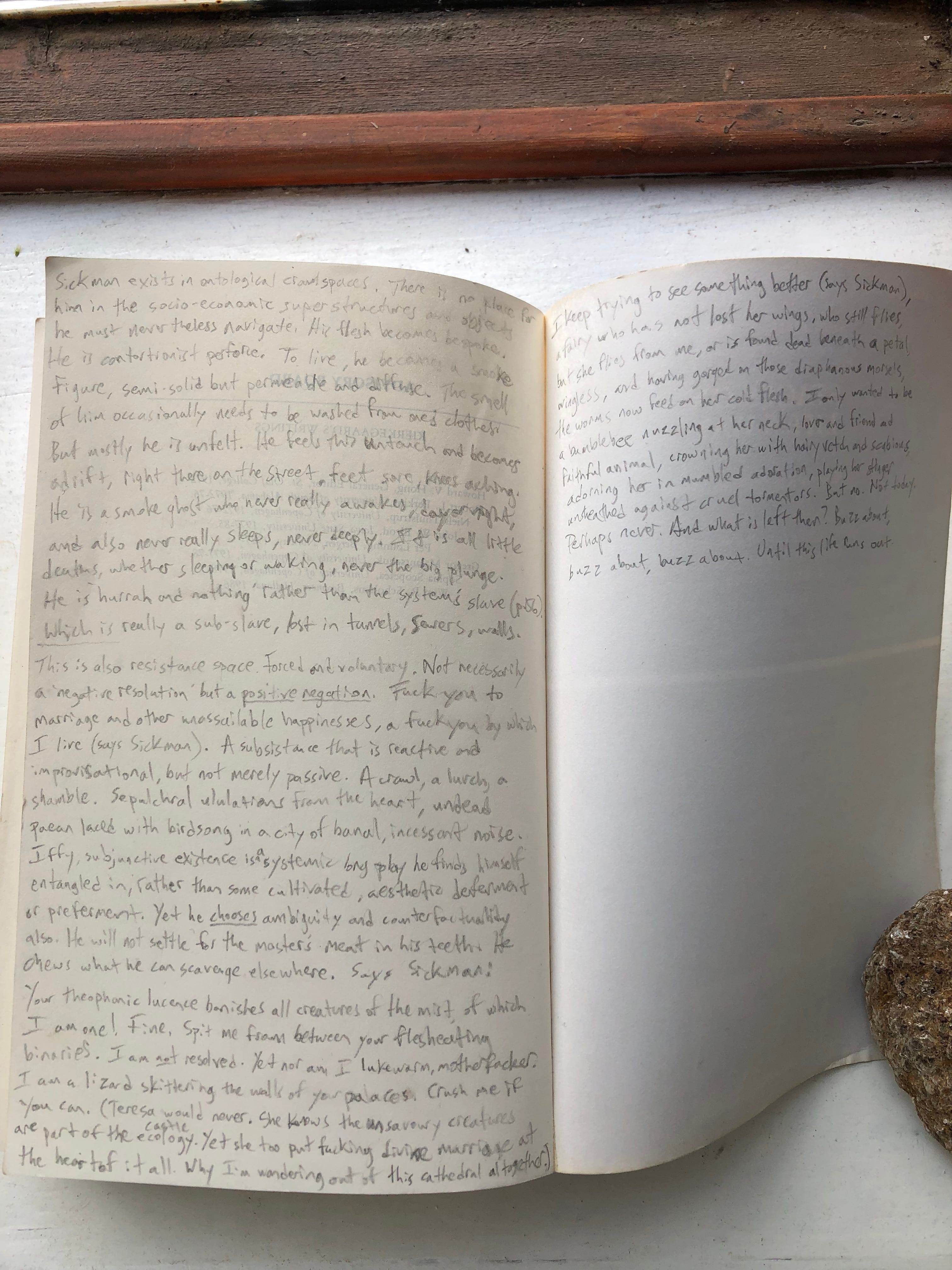
Lines written in the back of Kierkegaard's Stages On Life’s Way: Studies By Various Persons

Note: I suggest reading through the following short piece without consulting the (unwieldy) footnotes. If you are intrigued, perhaps you will want to read it again with their commentary.
The Sick One exists in ontological crawlspaces. There is no place for him in the socioeconomic superstructures and objects that he must nevertheless daily navigate. His flesh becomes bespoke. He is contortionist perforce. To live, he becomes a smoke figure, semisolid but permeable and diffuse. The smell of him occasionally needs to be washed from one’s clothes. But mostly he is unfelt. He feels this untouch and pops out, floats adrift, right there on the street, feet sore, knees aching. He is a smoke ghost who never really awakes, day or night, and also never really sleeps, never deeply. It is all little deaths, whether sleeping or waking, never the big plunge. He is ‘hurrah and nothing’ rather than the system’s slave. Which is really a subslave, lost in tunnels, sewers, walls.1
This is also resistance space. Forced and voluntary. Not necessarily a ‘negative resolution’ but a positive negation. Fuck you to cap-het hedonics and other unassailable happinesses, a fuck you by which I live (says the Sick One). A subsistence that is reactive and improvisational, but not merely passive. A crawl, a lurch, a shamble. Sepulchral ululations from the heart, an undead paean laced with birdsong in a city of banal, incessant noise. Iffy, subjunctive existence is a systemic longplay into which he finds himself engrooved, rather than some cultivated, aesthetic deferment or preferment. Yet he chooses ambiguity and counterfactuality, yes. He will not settle for the master’s meat in his teeth. No. He chews what he can scavenge elsewhere. Dust on a needle, the Sick One’s scratchy vocals (re)monstrate: Your theophanic lucence banishes all creatures of the mist, of whom I am one! Fine. Spit me from between your flesheating binaries. I am not resolved. Yet nor am I lukewarm, motherfucker. I am a lizard skittering the walls of your palaces. Crush me if you can. (Teresa would never. She knows the unsavoury creatures are part of the castle ecology. Yet she too put goddam divine marriage at the heart of it all. Why I’m wandering out of this cathedral altogether.)2
I keep trying to see something better (says the Sick One), a fairy who has not lost her wings, who still flies, but she flies from me, or is found dead beneath a petal, wingless, and having gorged on those diaphanous morsels, centripetal, the gladworms now feast on her softening limbs and relish the pungency of her rot. I only wanted to be a bumblebee nuzzling her neck, lover and friend and faithful animal, crowning her with hairy vetch and scabious, draping her in mumbled adoration, playing her stinger unsheathed against cruel tormentors. But no. Not today. Perhaps never. And what is left then? Buzz about, buzz about, buzz about. Until this life runs out.3
More reports to follow.4
Sickman (here alternately evoked as ‘the Sick One’) is responding emotively and erratically to several moments in Kierkegaard’s Stages On Life’s Way: Studies By Various Persons (1845). The first section of this very large book is titled In Vino Veritas, which furnishes a self-consciously Platonic symposium on ‘erotic love […] between man and woman’ (30-31)—with, conveniently, no women present to upset the discussion. (To be fair, Kierkegaard is certainly lampooning this group of aesthetes, yet on which points exactly is not always clear.) One of a handful of upperclass participants, each of whom gives a piquant speech on the topic, thanks the gods he was not born a woman. Then he remarks that if he had to be a woman, he’d rather be a slave (in the ‘Orient’ where, it is sweepingly implied, this is the universal female condition), ‘for a slave […] is still always something compared with being “hurrah” and nothing’ (56)—presumably the condition of women in the ‘Occident’. Sickman is still working out the intersectionality of his lifelong lower class and religiously repressed conditions with the concerns of feminism, but for now he often feels himself in at least adjacent conditions in his latterlife resistance to patriarchy and other systemic injustices. So, while hotly rejecting the speaker’s noxious Orientalism and acknowledging the crucial differences between his own white male privilege, even in poverty, and the conditions of women (especially of colour), Sickman, given the choice, prefers to be a (barely) existential ‘hurrah and nothing’ to being a slave in any sense. That is, to abide, if he must, as some ontological oddity between a celebratory shout lingering in the air and nothing at all. But this option is no escape, of course, for as he notes, this too is a (perhaps more underground) form of enslavement to the system’s strictures. Indeed, he finds fascinating parallels between Simone de Beauvoir’s magisterial feminist text The Second Sex (1949) and Kierkegaard’s Stages. (As it happens, In Vino Veritas is the sole text by Kierkegaard that Beauvoir quotes from in her tome, in several places. Sickman had no idea this was the case when he obtained and began reading the two in tandem.) Beauvoir seems to be both acknowledging and combating the frustrating reality of woman’s status as ‘hurrah and nothing’ throughout patriarchal history: ‘Because she is faux Infinite, Ideal without truth, she is revealed as finitude and mediocrity and thus as falsehood’ (Beauvoir 1949/2011: 210; cf. 278). Sickman does his best to listen, learn, and lend a dagger to intersectional revolt. (Some will call this performative. So be it. Sickman is a performer—and a performance. The issue, for all of us, is not whether to be performative or not, but to perform the truth—as best one can.)
The second section of Kierkegaard’s Stages on Life’s Way is a counterpoint to the first, titled Some Reflections on Marriage in Answer to Objections—By a Married Man. (Sickman has penciled in his own alternative title: The Fetishisation of Marriage and Its Uses for the State. Cf. 114, 117. Again, to be fair, this piece does not entirely represent Kierkegaard’s own view, but it is difficult to discern where the author differs from his pseudonyms.) This second section’s writer-character, a local court justice named Wilhelm (or Judge Billy as Sickman calls him), proffers a binary between ‘positive resolution’ and ‘negative resolution’ in regard to marriage (107 ff.)—that is, to resolve to enter it in unqualified faith or to resolve to abstain from marriage by some conscious individual principle. Sickman, as so often, situates himself as a Tertium Quid Kid and opts for a third thing, what he calls a ‘positive negation’ in regard to marriage (in its capitalist, heteronormative iterations). That is, Sickman’s rejection of this institution proceeds not from an ‘anti-’ but from a ‘pro-’ that hasn’t yet found its object. As if anticipating Sickman’s move, however, Judge Billy further asserts that the liminal denizens of such unresolved ne(i)therground are forgers and thus outside the scope of God’s light: ‘If a person in the moment of resolution is not so glowingly surrounded by the brightness of the divine that all phantasms created by the fogs of drowsiness vanish, his resolution is but greater or minor forgery—let him find consolation in the outcome’ (110). But, as Sickman insists, he is not falsely resolved but unresolved and such phantasmal subsistence is not that of the lukewarm or mere fencesitters. It is a survival strategy of binary-denying creatures deemed lesser by the citadels of good citizenship. As one such lesser (or rather, lessened) creature himself, Sickman here ambivalently reaches for Teresa of Ávila’s characterisation of reptiles as ‘poisonous’ yet ultimately beneficial denizens of the human soul in her 16th century visionary masterpiece Las Moradas (The Mansions, sometimes titled The Interior Castle). Cf. The Interior Castle, Paulist Press, 1979: pp. 45, 49, 52. Perhaps such glow as these creatures may possess is bio- rather than theo-luminescent (yet intermittently commensurate with the traces of sacred foxfire emitted by decaying monotheisms). See also Proverbs 30:28 (where Sickman finds his onticity sliding back and forth between the spider and lizard translations).
In his final paragraph here, Sickman riffs on Judge Billy’s remark that the ‘unhappy individuality’ of one who tries to ‘think himself into’ the erotic is ‘like that solitary fairy who has lost her swan’s wings and now sits there abandoned, vainly, despite all her efforts, trying to fly’ (120). Such a one ‘is excluded from the benevolence of immediacy, for which one cannot really manage to give thanks since the benevolence always hides itself’ (121). Though Sickman is more a feeler than a thinker, and he in fact seeks the hidden benevolence, Judge Billy would no doubt condemn him (however empathetically) with the words of the subsequent paragraph: ‘Just as it is sad to see the misery of that solitary fairy, so, too, it is sad to see all the mental exertions of such a person, whether he suffers in silence or with a demonic virtuosity in reflecting he knows how to conceal his nakedness with clever words’ (ibid.). Obviously, Sickman breaks his silence and opts instead for Demonic Virtuosity in his public writing (or some shambling approximation thereof). But can we really begrudge the naked sick one their sewing of such a wordgarment against the elements, with the tired but clever hands of recalcitrance? For not all are blessed with the garment of divine refulgence. In this regard, it is worth noting some other names (in addition to phantasm, forger, and wingless fairy) that Judge Billy calls Sickman and his kind (i.e. the unresolved, the non-leapers): poor wretch, mutineer, protested outcast, stranger to joy who weeps and gnashes his teeth (112); beggar (116); ‘a suspicious character whom we eventually ought to take into custody’ [fucking cop!] (117); petty chicaners, arsonist freebooters, lurking spies, home-intruder vagabonds (119); ‘streetwalker’ [sexworker] (122); ‘a bankrupt whom life itself ruined’ and whose breakup ‘afterpains’ are ‘punitive suffering’ (179); ‘the shattered ones’ (180); ‘the annihilated ones’ (182). The judge does hold out hope for these benighted (unknighted) souls to cross over into the light, but on terms Sickman refuses to broker.
Sickman is about a quarter of the way through the final and longest section of Stages on Life’s Way, entitled “Guilty?”/ “Not Guilty?”: A Story of Suffering, a series of anonymous diary entries with an appended long letter by their compiler, one Frater Taciturnus. Here Kierkegaard at last comes very slowly and painstakingly to the point he had in mind all along, the religious transcending (and thereby incorporating) of the erotic and the ethical, the topics of the first two sections of the book respectively. It is both beautifully and playfully written and yet almost too serious, too severe. Of course, this is just Kierkegaard’s tortured genius, part of the package. Sickman is taking to it far better than the book’s first two sections. Yet it is full of its own pitfalls for him to navigate.