
SUITED
A Children of Compost episode.

for Camille 2
bearded with butterflies
Her tall, hench mech hugs every inch of her to himself with visceral and velvet completion. Having opened like a great flower only a moment before, all his hasps and latches close back, now literally enfleshed, with her, with them. Truly one again. Always together by biotec1 relays, of course—qualia synced, murmuring—but here, now, doing the allegedly, logically, Leibnizianly impossible: occupying the same exact space on the planet, indiscernible, but not identical. She knows she’s fanciful and not strictly rigorous when she loosely conceptualises their union this way. (Her philosophy instructor from her home village would be holding her head in her hands.) But when she feels his hard, strong grip on her thighs, biceps, traps, fingers, ass, cheekbones, toes, Dr. Bethany Arbour doesn’t want to be too logically tight. She wants to be this tight, symchthonic, Terran, syllogisms in metal and flesh, conphantasmagorical in vision and quest.
Suited.
Cupping her firmly at the crotch, the neck, yet everywhere so breathable, supple fiber meshworks ever adjusting to micromovements, anticipating her body’s needs, moves, moods. His mycorrhizal nodes enter her nostrils for nerve syncopation and she can feel the coolness of his floral inner sheath storing oxygen and energy all around her. At the base of her back, a wince from fresh incisions as he jacks into her frisson centres. She gasps. She almost always does. (There are options for permanent surgical inputs, but this constantly repeated procedure is their innovation, something she’d first theorised in her doctoral thesis, a not entirely unpleasant fusion of unheimlich and abject, scabs instead of scars.) The outer weft of the mech is skintoned at the joints, his smooth fernhued green broken by her bendy brown hingepoints. She’d worried it would be a claustrophobic nightmare. It’s the exact opposite: she never feels so free and so networked to her environs, whatever the niche or biome, than when suited. A series of small but satisfying tremors from scalp to soles starts things right, and the afterpiss, he recycling her fluids through himself, her exoself, their sympoietic self. (A union not entirely without controversy, even in this day and age. Some communities still shun them.)
His moulting a fortnight finished, she tilts their head this way and that with the gyroscopic delight of his full crown of antlers. The deer are her sym and you can see it in her large, doe-like eyes. The wolves are his simsym, signalled in his pointed, twitching ears. Yet each has a genetic feature of the other’s animal, he the antlers, she a fine pelt of silver fur on her abdomen.
“Ready, Freddy?” she says with a grin in her voice. They like to speak aloud even though their thoughts are linked. (He’d defended a notion of machinic agency he termed “freedetermined” in his own doctoral thesis. Hence, her nickname for him.)
“Steady, Betty,” he replies in kind, right into her ears, soft, clear, just right. Thrusters heat in a half second and her stomach drops as they jump. She laughs. She almost always does. The sidereal blue blasts from their feet perforate the predawn dark and illumine dimly a horned figure in the sky. Theirself.
“Let’s go see what this psychomagmatic activity is about,” he says, all business.
“Let’s!” she replies, a little less than all business, as she pilots them toward the Hives. Her name for the inactive volcanic range, which, to her, looks for all the world like the work of giant insects. (She stole that image from an old, bloody, psychedelic cowboy novel.) The wolf and deer population of the range went all shuddery late last night and the region’s kinwork can feel it this morning. Hence, this exploratory mission. They run point on these and call in others as needed.
“Mama’s tummy’s upset, I bet,” ventures Freddy.
“Eh,” says Betty. “Maybe it’s her brain that’s rumblin’, cookin’ up somethin’ new.”
“Mm, doubt it,” says Freddy.
“Well okay, Renny DayCart,” she teases, rolling her eyes.
Over the corridor of climax prairie en route to the volcanoes, ructions of concrete show through here and there below, though the highways were swallowed up centuries ago. Granting wide berth to a screaming flock of geese, the foothills come into view.
They clock the pack first. Moving at a clip.
“Are we hunting?” he wonders aloud.
She hesitates, then mumbles, “Only prey I can detect is too far for an all out run like that.”
They arc away, scanning. Another pack before long, also full tilt.
“Wolves aplenty, but no deer,” she says.
“Yeah,” he agrees. “I don’t think we’re running from something either.”
“No,” she says. “I think you’re chasing something else.”
Then they feel it. He mirrors her gooseflesh as his inner ductility makes room for the tiny upthrusts all along her spine and arms and scalp and thighs.
“Shit!” she breathes as they barely roll away from a collision with something unconscionably gigantic in the air, which they can’t see but otherwise sense with bone certitude and not a little dread.
The wolves howl. Then the howling’s doubled. Another pack is converging with the first from the northwest. Scores of lupine eyes limn the vast invisibility above them.
“You okay?” he says.
“You’re monitoring my heart rate, what do you think?”
He chuckles and she feels the cascade of soft booms in her breastbone. She grins. She almost always does.
“How are you?” she asks.
“We’re not sure.” They look down at the packs, yipping, flanking.
Shaking off this sacred jumpscare a little, they make a long perimeter around their best guess of the holy thing’s girth.
“Report it you think?” she asks him.
“Mm, yeah, probably oughta.”
“Ontological shift perceived,” she messages the research base and rehearses the coordinates, a verbal confirmation of what the locators will tell them anyway, along with the possible shape and size their flight has suggested thus far. She notes their tremendum/fascinans too, the nervous system surplus, again already monitored but now verbally registered.
“The deer have gone to ground, I guess,” he says.
“We’re troubled and hiding, yeah, but I don’t think we’re in terror. Just cautious. Curiosity’s gonna get the best of us before long.”
Having steadied their nerves and made their report, they intone prayers of greeting, respect, and protection. Whether this is transitory or taking up residence will probably become clear within the week.
“Goddins!” she swears. “This hasn’t happened in our lifetime.”
“Fuck me,” he says. “The range may be receiving a new god.”
“Fuck,” she concurs.
Numina return very slowly and tentatively in this age, only a few a century perceived so far, usually through sym kin first, as in this case. As long as they don’t prove to be angry or malevolent (for which cases there are various contingencies), the biomes just as slowly and tentatively learn to welcome and incorporate these beings into their kinwork.
BettyFreddy camp in a saddle of the mountain for the day and by evening they start to see deer emerging, avoiding the wolves but seeking out this new, perhaps old, deity. For their own part, Betty gets little sleep, and even Freddy, constitutionally sleepless, is not untroubled. Through watch after watch, their minds bear the heft of that vast presence that blots out no stars, yet occludes the night even so. The following morning, satisfied that the range’s population is in no danger for the time being, they make more prayers and return to the buzz and bustle of a very inquisitive village, and still later make a report in person to the research base. Elders and youth set to with enthusiasm on prospective ceremonies and their imagery, garb, and accoutrements, even though these will only firm up across decades of encounter and negotiation, and ever be open to further transformations.
So goes the world and its worldings.
So ever will it be.
Ever different, ever returning, and never again.
COMMENTARY:
This too is wormsigh. Sickman2 wrote the above right here on this platform over the past week. (Does anyone else do this? I’ve done it more than once.) With a mech in his head, he opened up a new draft post and began to write. He’s loved mechs since he saw Robotech as a kid and he delighted in their apotheosis in Neon Genesis Evangelion when he finally watched that series for the first time back in 2020. He was thus disappointed to recently hear (anecdotally) that Elon Musk loves mechs, not least from these two shows. It makes sense, I suppose. Yet these shows (not at all without their problematics) are excruciatingly fraught with the woes and reversals and mysteries of such human-machine intersections. They are far from brighteyed optimism. Sickman was never overly enamoured with military s.f., nor robot fiction (or heavily technological fiction of any variety), but mechs were always an exception. Perhaps his heart burst forth with this post’s hot take on a beloved genre so as to cope with the technocapitalist optioning of that contested imaginary (gundam, mech, etc.). As I say, this too is wormsigh. A feeling forth for some alternative to warring and instrumentalised futures.
And thereby he backed into the stories of the Children of Compost.
Trade secret: academics haven’t always finished reading the books they cite. Perhaps especially when the book’s chapters are a patchwork of previously published material, as is the case with Donna Haraway’s Staying with the Trouble: Making Kin in the Chthulucene (2016). Even though Haraway’s book features heavily in Sickman’s PhD thesis and subsequent academic essays, he had never got round to reading the book’s final chapter, “The Camille Stories: Children of Compost”, until this week. He had already written the first several paragraphs of the above story fragment and then found himself inexplicably seeking out Haraway’s final chapter. He knew it was about future hybridities, what Haraway calls ‘sympoeisis’, making the world together with humans and nonhumans (‘humus’ is her replacement term for ‘human’). Camille is a series of characters through five generations (hence Camille 1, Camille 2… Camille 5) who genetically bind themselves to a migratory nonhuman population, in Camille’s case, the monarch butterflies of certain eastern and western corridors of North America. The Camilles have some exquisitely weird manifestations of this sympoiesis in their bodies. I’ll leave you to go read about them. Haraway calls the people of these communities ‘compostists’ rather than posthumanists. Sickman thinks it’s a great rhetorical move. He’s a compostist too.
Sickman’s characters here started in a mesh, but that mesh became more messy—and more fruitful and strange (and seemingly impossible, yes, yes)—as his reading of the Camille chapter infected this piece. (Morton’s in here too. Cormac. Miyazaki. Le Guin. Cronenberg. Bateson. Silko. Blackwood. Jones. Probably others.) It’s just a sketch. He doesn’t know if he’ll turn it into an actual Children of Compost story (or any submittable story at all). But he finds pleasure in these exercises and trusts they contribute to whatever he does eventually write for print publication.
He’d also love to hear your writerly remarks. Please share your own writing experience and advice if you like. As to this piece or more generally. He’d most certainly take it into consideration.
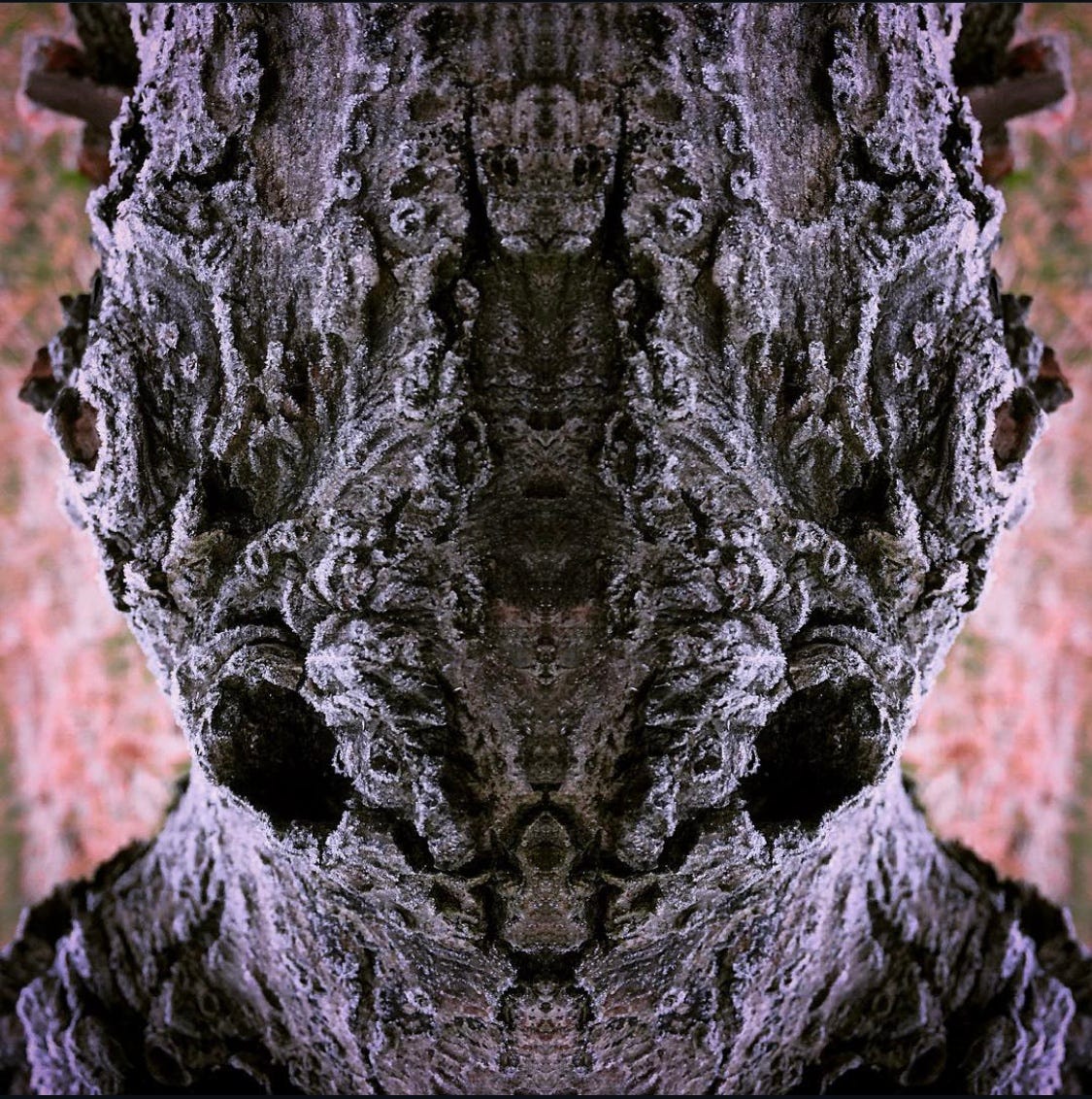
More reports to follow.
Neither ‘biotic’ nor ‘biotech’, but some liminal third thing.
That is, the Sick One: he writes from disability, precarity, injury, ‘unemployment’, bewilderment, and beleaguered ‘mental health’. He doesn’t see a horizon wiped away by the death of a deity, like a certain heavily memed Madman. But what he does see is hard to say, and it flickers, sometimes out. Sometimes back in again. I narrate him as a philo-fiction. Or better, a philosophiction—so as not to erase dear Sophia. Wisdom may not be fashionable to either ‘analytic’ or ‘continental’ strains, and ever so chimerical and manipulable by bad faith philos, yet Sickman still pursues her with the ancients and probably the futures.